
This guide reviews the customs, symbols, and alternatives — so you can wear your ring exactly the way you want.
The Western tradition: the left ring finger
In most Western countries — France, Belgium, the United States, the United Kingdom — the engagement ring is worn on the ring finger of the left hand. This tradition dates back to Roman antiquity and the belief in the vena amoris: the “vein of love,” thought to connect this finger directly to the heart.
Although this vein does not anatomically exist, the symbol has remained. The left ring finger is now the engagement and wedding finger in almost all Western cultures — and wearing your ring there is immediately understood by everyone.
Depending on the country and culture
The left hand is not universal. In many European countries and cultures, it is the right hand that traditionally holds the engagement ring and then the wedding band.
| Country / Culture | Hand | Finger |
|---|---|---|
| France, Belgium, USA, UK | Left | Ring finger Tradition |
| Germany, Austria, Norway | Right | Ring finger |
| Spain, Greece, Russia | Right | Ring finger |
| India | Right | Ring finger or middle finger |
| Brazil | Right (engagement) → Left (wedding) | Ring finger |
Whatever your country's tradition, the ring finger remains the quintessential engagement finger — whether left or right, depending on your culture.
Can you wear your engagement ring on another finger?
Yes, absolutely. Tradition is a reference point, not an absolute rule. Some women wear their engagement ring on their middle finger, index finger, or even thumb — for aesthetic reasons, for comfort, or because their ring finger does not match the ring's standard size.
When you can’t wear it on your finger
Sometimes wearing your engagement ring on your finger simply isn’t possible: manual work, sports, a medical profession, pregnancy, metal allergy, or a ring that is too small while waiting to have it resized. In these cases, an elegant alternative exists.
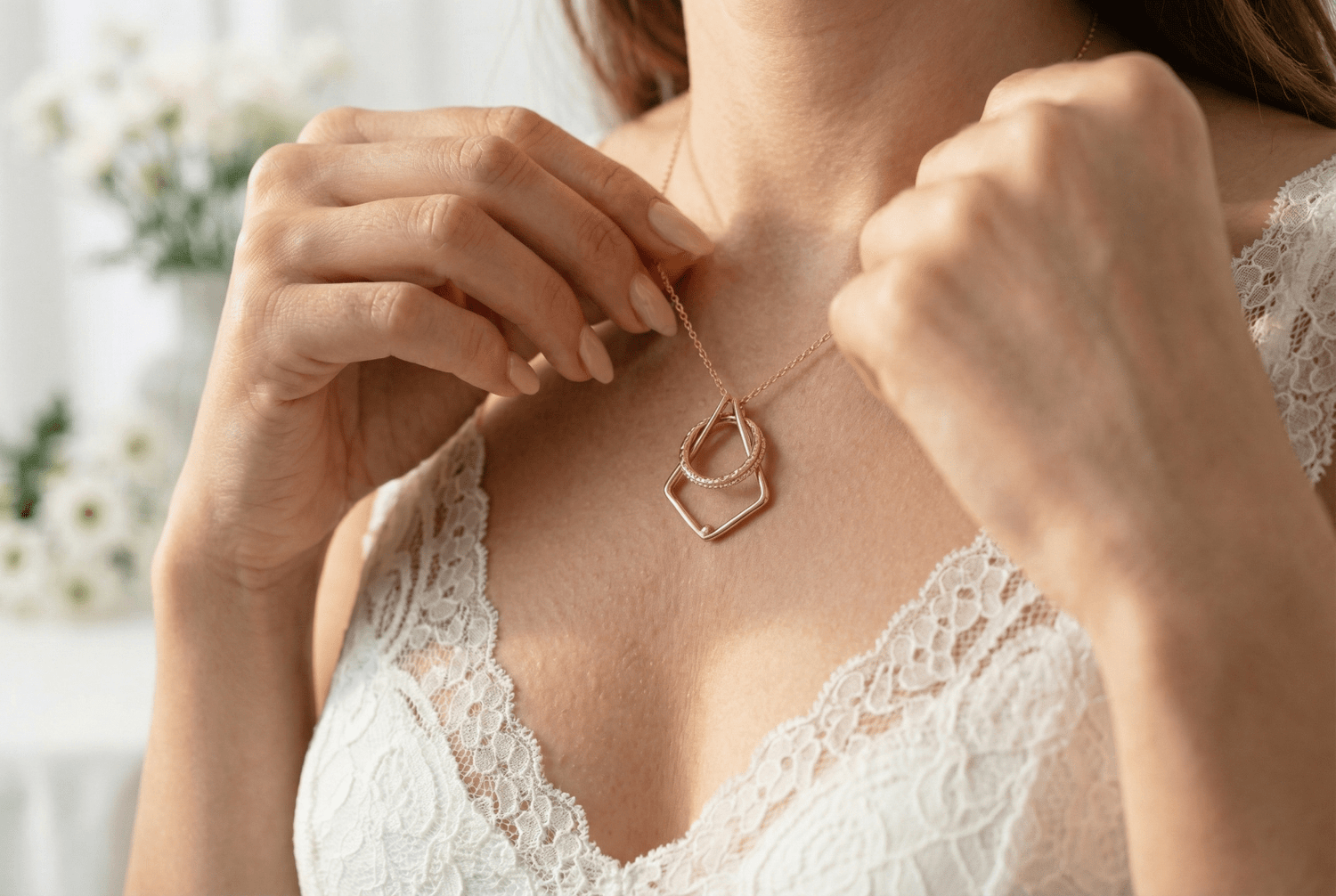
Wearing your ring around your neck with a women’s ring holder necklace lets you keep it with you at all times, without the risk of losing or damaging it. The ring stays visible, close to you — and the act of wearing it around your neck feels deeply intimate.
See ring holder necklaces →How to make a ring holder necklace with a simple chain
No need for a special necklace — a fine chain is enough. Here’s how to do it in under a minute:
Simply slide your ring onto the chain before fastening it — that’s all.
Engagement ring and wedding band: how to wear them together?
On the wedding day, tradition has it that the wedding band is slipped on first, closer to the palm — a symbol of the priority of the marital bond. The engagement ring then goes on top.
- Before the wedding: engagement ring alone on the left ring finger.
- During the ceremony: engagement ring moved to the right ring finger for the exchange of wedding bands.
- After the wedding: wedding band first (palm side), engagement ring on top.
- Alternative: some women wear the two separately — one on each hand — to let each piece breathe.
Mistakes to avoid
- Check your ring size before buying
- Take off your ring for sports and manual work
- Use a ring holder necklace if you can’t wear it on your finger
- Have the ring resized if it feels too tight or spins too much
- Clean regularly to keep its shine
- Wearing the ring while doing the dishes or cooking
- Leaving it in its box for fear of damaging it
- Forcing it onto a finger that has swollen
- Putting it down just anywhere — it can slip and get lost
- Mixing metals without consistency (gold + silver without intention)
Frequently Asked Questions
Which finger do you wear an engagement ring on in France?
Can you wear your engagement ring on your right hand?
How should you wear your engagement ring when you work with your hands?
In what order should you wear a wedding band and engagement ring?
Can you wear your engagement ring as a necklace?
What chain size should you choose to wear a ring as a necklace?
In summary
The engagement ring is traditionally worn on the left ring finger in France — but the right hand is just as valid depending on your culture or preferences. What matters most is that you wear it with joy, every day, in a way that feels like you.
And if the finger isn’t an option, a beautiful women’s necklace remains the loveliest alternative for keeping this piece of jewelry close to you — and close to your heart.






Leave a comment
This site is protected by hCaptcha and the hCaptcha Privacy Policy and Terms of Service apply.